How to listen to music at low volume: the practical guide to late-night listening
A practical guide to high-fidelity listening at reduced volumes: why music loses detail in the evening and how to configure your setup to avoid disturbing the neighbours without sacrificing quality.
How to listen to music at low volume: the practical guide to late-night listening
For those who love high fidelity, the finest moment of the day is often the evening: the house grows quiet, the lights go down, and you can finally sit back to enjoy an album. This idyll, however, almost always clashes with a harsh reality: living in an apartment block, neighbours just on the other side of the wall, or children sleeping in the next room.
The immediate reaction is to turn down the amplifier volume. The result? Frustrating. The music suddenly seems to lose its life: the bass vanishes, vocals recede, and those fine details that made the track emotional disappear into thin air. Before thinking your setup is faulty, rest assured it is not the fault of your components, but rather the way the human ear operates. Fortunately, there are tricks and technologies to solve this problem.
The mystery of vanishing bass: a matter of psychoacoustics
The reason music sounds “hollowed out” at low volumes is purely biological. Our auditory system evolved over millennia to focus on midrange frequencies (those of the human voice and immediate dangers). Consequently, the human ear is highly efficient at middle frequencies, but becomes lazy at the extremes – deep bass and ultra-high treble – when sound pressure drops.
In simple terms: the more you lower the overall volume, the less your brain perceives bass and treble relative to vocals. To achieve a balanced and linear listen even late at night, we need to give our audio system a little geometric and technological helping hand.
1. The secret weapon: Dynamic Loudness
In the last century, vintage amplifiers featured a physical button called “Loudness”, which applied a fixed equalisation to boost bass and treble when listening to music at a whisper. Today, smart electronics have resurrected and perfected this concept in the form of Dynamic Loudness.
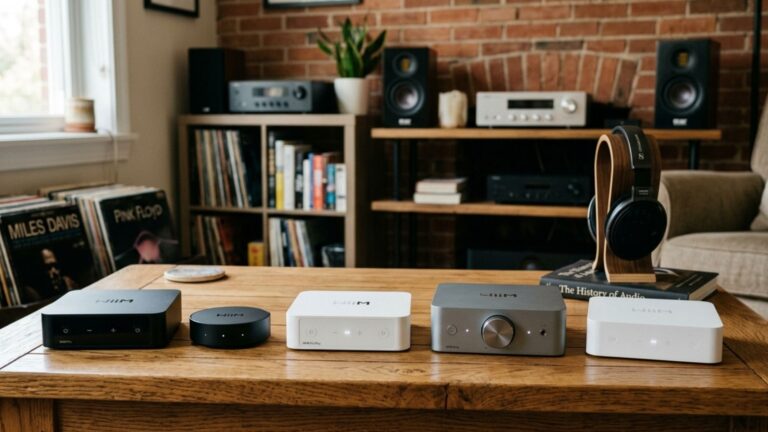
Modern streamers and intelligent amplifiers do not apply a fixed EQ curve; instead, they read the volume in real time. The more you turn down the dial, the more the processor gently compensates for the ear’s natural loss of bass and treble. If you are looking for a modern device that handles this feature flawlessly via an app, we recommend reading our comparative market analysis in our WiiM devices comparison guide, where we break down the sound processing capabilities of each model.
2. Layout and vibration control
To avoid upsetting the neighbours, your number one enemy is not the sound travelling through the air, but the mechanical vibrations that speakers transfer to furniture and walls. Low frequencies propagate through solid structures like shockwaves.
- Decouple your speakers: If your loudspeakers sit directly on a wooden TV unit or desk, the entire piece of furniture becomes a sounding board, transmitting a low-end rumble into the floor. Use small rubber isolation feet or high-density foam pads under the speakers to break this energy transfer.
- Mind the distance from walls: As we explored in depth in our guide on where to position Hi-Fi speakers, placing cabinets close to a wall artificially boosts bass presence. While this might be pleasant during the day, at night it risks creating uncontrollable rumbles that travel straight through apartment walls. Pull your speakers away from the rear wall by at least 20-30 centimetres.
3. Choosing the right components for small spaces
You do not need a massive, expensive system to enjoy immense detail at lower volumes. Often, a compact and well-optimised setup offers far superior micro-dynamics (the ability to reproduce subtle nuances at low volume) than large, hard-to-drive floorstanding speakers.
If you are setting up a secondary system for a bedroom or have a modest starting budget, you can assemble an excellent and highly detailed acoustic chain even with limited funds, as shown by the options selected in our Hi-Fi setup under 500 euros guide. Conversely, if your budget is more flexible and you want to understand whether it is better to opt for the compactness of powered speakers or the modularity of a separate smart amplifier, you can head over to our deep dive on the Hi-Fi setup under 1000 euros.
💡 Practical tips for a cosy late-night listening session
If you want to immerse yourself in the perfect cosy atmosphere tonight without sacrificing quality, try following these quick steps:
- Utilise a tight triangle: Bring your chair or armchair closer to the speakers, creating a smaller equilateral triangle. By reducing the physical distance between your ears and the loudspeakers, you can drop the amplifier volume drastically while still catching every tiny nuance of the track.
- Dampen room echo: A sparse, empty room amplifies sounds and forces you to lower the volume even further because the audio becomes harsh and reflective. Thick curtains, cushions on the sofa, and a good rug help absorb primary reflections from the floor, allowing for a much warmer, more natural, and focused late-night listen.
Listening to music at night holds a unique charm. By applying these small adjustments and leveraging the technology of modern smart systems, you can enjoy your favourite albums late into the night, rediscovering hidden details while maintaining total peace in your building.